Spend a bit of time in any room, and you’ll start to notice how sound behaves. It bounces, carries, and lingers in ways that aren’t always obvious at first. Some spaces feel easy to sit in and talk, while others feel slightly overwhelming, even when nothing looks out of place. More often than not, the difference comes down to how sound is being managed.
Acoustic panels are one of the most effective ways to improve that experience, but their placement matters just as much as their quality. Installing panels without a clear plan often leads to mixed results. On the other hand, placing them in the right positions can completely change how a space feels, without altering its layout or design.
Understanding where to position acoustic panels starts with understanding how sound moves.
Why placement matters more than quantity.
A common misconception is that more panels automatically mean better results. In reality, it’s not about covering every wall. It’s about targeting the areas where sound reflections have the most impact.
Sound travels outward from a source, reflects off surfaces, and eventually reaches your ears. The problem arises when those reflections arrive slightly delayed and from multiple directions. This creates a sense of clutter, where voices overlap, and clarity starts to drop.
Well-placed panels reduce these reflections at key points, helping sound feel more direct and controlled. Even a small number of panels can make a noticeable difference when positioned correctly.
First reflection points should come first.
The most important areas to treat are the first reflection points. These are the areas on your walls where sound first strikes before it reaches your ears.
In a typical setup, this happens along the side walls. For example, if you’re sitting in a living room watching television or in a home office on a call, sound travels from the source and reflects off nearby surfaces before reaching you.
A simple way to identify these points is by using a mirror. Sit in your usual spot and have someone slowly slide a mirror along the wall. The moment you can see the sound source in the mirror, you’ve identified a reflection point.
Placing wall panels here helps reduce early reflections, which improves clarity and makes conversations easier to follow. It’s one of the most effective changes you can make with minimal effort.
The wall behind the sound source.
Another key area is the wall directly behind your main sound source. This could be the wall behind your speakers, television, or even a desk where most conversations happen.
Sound hits this surface almost immediately after leaving the source. Without treatment, it reflects straight back into the room, adding to the overall build-up of sound.
Installing acoustic panels in this area helps absorb those reflections early on. This keeps sound from bouncing back too aggressively and improves how it spreads throughout the room.
It’s a simple adjustment, but it has a strong impact on how balanced the space feels.
Behind your seating or listening position.
The wall behind where you sit is often overlooked, but it plays an important role in how sound is perceived.
Once sound passes you, it continues to travel until it hits the rear wall. From there, it reflects back towards your ears with a slight delay. This can create a sense of echo or make speech feel less defined.
Adding panels to the rear wall helps absorb these returning reflections. The result is a more focused sound that doesn’t feel like it’s bouncing back at you.
This is particularly useful in living rooms, meeting spaces, and home offices where people spend extended periods in one position.
Large empty walls need attention too.
Big, bare wall surfaces are one of the main contributors to poor acoustics. Even if they’re not directly in the path of sound, they still reflect energy back into the room.
Treating these areas helps reduce overall reverberation, which is the lingering effect of sound bouncing around. You don’t need to cover the entire wall. A well-spaced arrangement of panels can be enough to break up reflections and improve the overall sound environment.
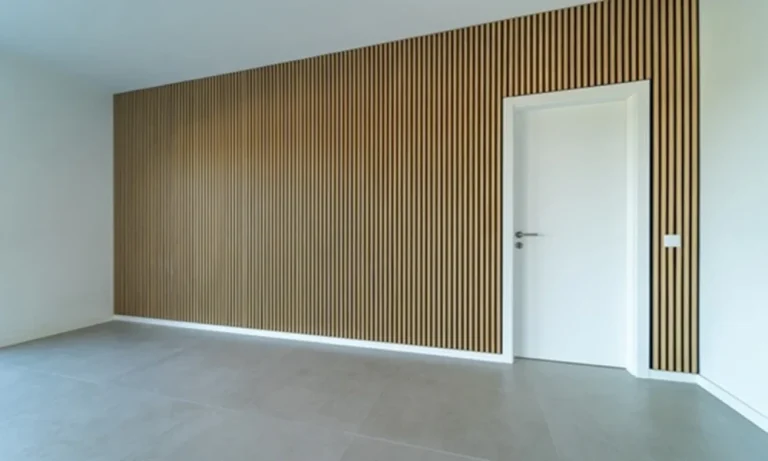
This is also where acoustic panels can double as a design feature. Many modern panels come in different shapes, colours, and finishes, allowing them to blend into the space or stand out as part of the interior design.
Corners and low-frequency build-up.
Corners are where low-frequency sound tends to collect. This is especially noticeable in rooms used for media, music, or presentations.
If a space feels heavy or slightly boomy, corners are usually the reason. Standard flat panels can help to a degree, but thicker panels or specialised bass traps are more effective in these areas.
Treating corners isn’t always necessary for every room, but it can make a significant difference in spaces where sound quality is more critical.
Balance across the room.
Good acoustic treatment isn’t about focusing on just one wall. Sound moves throughout the entire room, so panels should be distributed in a balanced way.
Clustering all panels in one area can leave other parts of the room untreated, which limits the overall effectiveness. Instead, it’s better to address key areas across multiple surfaces.
Start with reflection points, then move on to the wall behind the sound source and the rear wall. From there, you can assess whether additional coverage is needed on larger surfaces or corners.
This approach keeps the space feeling natural rather than over-treated.
Practical considerations for everyday spaces.
Not every room needs a studio-level setup. In most homes and offices, the goal is simply to make the space more comfortable for daily use.
That means focusing on areas where people spend the most time. In a living room, this might be around the sofa and television. In an office, it’s usually around desks and meeting areas.
Even a few well-placed panels can improve how a space feels during conversations, calls, or shared activities. The change is often subtle at first, but it becomes more noticeable over time.
You may find that people don’t have to repeat themselves as often, and the overall environment feels less tiring to be in.
Final Thoughts
Acoustic panels are most effective when they’re placed with intention. Understanding how sound travels through a room helps you identify the areas that need attention the most.
Rather than covering every surface, focus on key positions like first reflection points, walls behind sound sources, and the space behind your seating area. From there, you can build out your setup depending on the needs of the room.
When done properly, the result isn’t just better sound. It’s a space that feels more comfortable, more balanced, and easier to spend time in, whether you’re working, relaxing, or simply having a conversation.